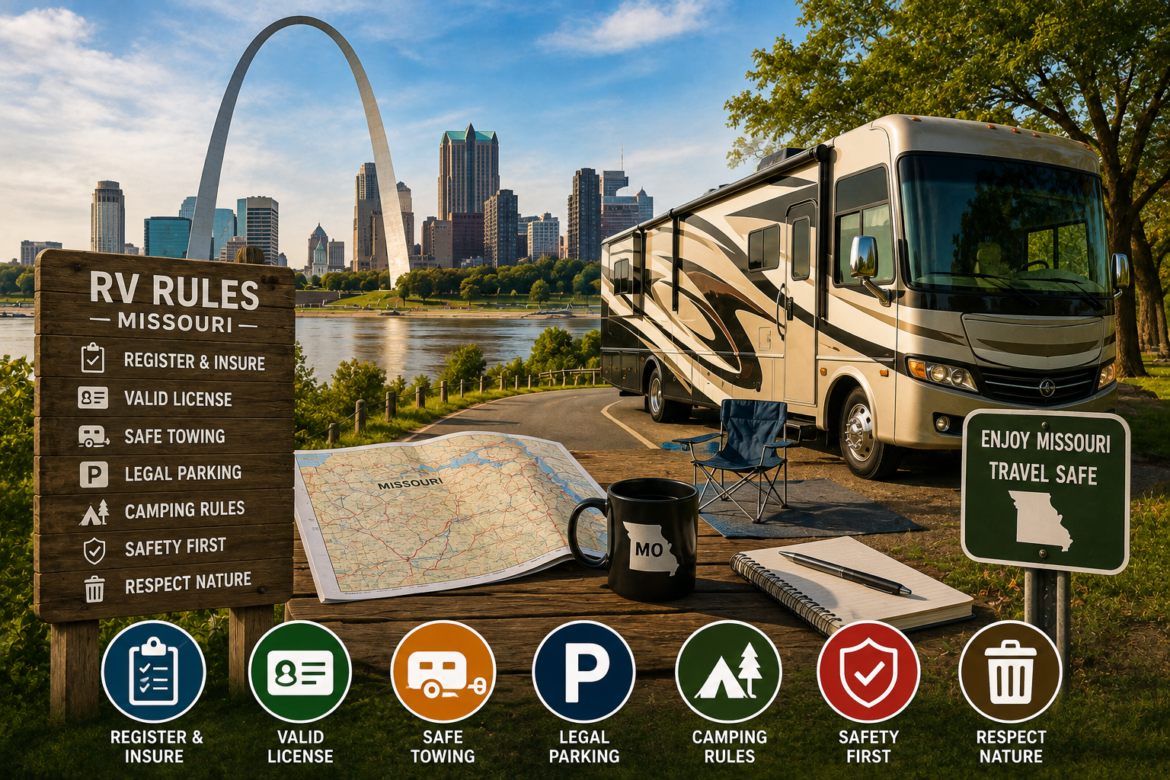
Traveling by RV through St. Louis and Missouri is a great way to enjoy scenic highways, historic towns, state parks, barbecue, baseball, and the famous Gateway Arch. However, RV owners need to follow several rules involving registration, licensing, towing, parking, camping, safety equipment, and local ordinances.
Missouri’s RV laws are generally manageable, but they can vary depending on where you are staying. State laws apply across Missouri, while cities, counties, campgrounds, parks, and private businesses may impose additional requirements. Knowing the basics before you leave can help prevent tickets, delays, and unpleasant surprises during your trip.
Registering and Titling Your RV in Missouri
An RV that is operated on Missouri highways generally needs to be properly titled and registered. Missouri requires owners of motor vehicles and trailers operated on state highways to file an application for registration with the Department of Revenue.
This applies to several common types of recreational vehicles, including:
- Motorhomes.
- Class A, Class B, and Class C RVs.
- Travel trailers.
- Fifth-wheel trailers.
- Campers and other qualifying recreational vehicles.
If you purchase an RV, you should complete the title and registration process within the required time. Missouri Department of Revenue guidance states that buyers generally have 30 days to apply for a title after purchasing a vehicle.
When registering an RV, you may need documents such as:
- The properly assigned certificate of title.
- A bill of sale or purchase agreement.
- Proof of insurance, when required.
- A safety inspection or emissions document, if applicable.
- A paid personal property tax receipt or an applicable statement.
- Identification and proof of address.
- Payment for title, registration, processing, and other applicable fees.
Missouri offers one-year and two-year registration options for qualifying vehicles. The state’s listed recreational vehicle registration fee is $32.25 for one year or $64.50 for two years, in addition to processing fees.
If you are moving to Missouri with an RV registered in another state, check the Department of Revenue’s new-resident requirements. You may need to transfer the title, register the vehicle in Missouri, and satisfy local tax or inspection requirements.
Emissions Testing Around St. Louis
Some RVs and motorhomes may be subject to emissions inspection requirements depending on where they are registered and the vehicle’s qualifications.
Missouri identifies St. Louis City, St. Louis County, St. Charles County, and Jefferson County as areas where an emissions inspection may be required for applicable vehicles. The inspection generally must be recent when you apply for title or registration.
Not every RV is automatically subject to emissions testing. Requirements can depend on factors such as:
- The vehicle’s model year.
- The vehicle’s weight.
- Whether it is gasoline-powered or diesel-powered.
- Whether it is registered in an affected area.
- Whether it falls under an exemption.
Before visiting a license office, check the latest Missouri Department of Revenue requirements. Bringing an outdated or incomplete inspection document can delay registration.
Driver’s License Requirements
Many RV drivers can operate their vehicles with a regular Missouri driver’s license, but the exact requirement may depend on the RV’s size, weight, classification, and how it is being used.
A personal-use motorhome is generally treated differently from a commercial vehicle. If you are driving an RV for personal travel, you should still confirm that your driver’s license class is appropriate for the vehicle you plan to operate.
The situation may be different if you are:
- Driving a very large or heavy vehicle.
- Towing a trailer for commercial purposes.
- Transporting passengers or property for compensation.
- Operating the vehicle as part of a business.
- Driving a combination that falls under commercial motor vehicle rules.
If your RV trip involves commercial activity, ask the Missouri Department of Revenue or Missouri Department of Transportation whether a commercial driver’s license, medical qualification, operating authority, or additional documentation is required.
Do not assume that the license rules for a passenger car automatically apply to every RV combination. Check the motorhome’s gross vehicle weight rating and the trailer’s weight before starting your trip.
Missouri RV Towing Rules
Towing a travel trailer, fifth-wheel, boat, or vehicle behind an RV requires careful attention to equipment and weight limits. Missouri law requires a towed vehicle to be connected by a safety chain, cable, or equivalent secondary device in addition to the main coupling system in many situations. The safety connection must be strong enough to control the towed vehicle if the primary connection fails.
A safety chain should be:
- Properly rated for the trailer’s weight.
- Crossed beneath the coupler when appropriate.
- Attached to secure points on both vehicles.
- Short enough to prevent the trailer tongue from hitting the ground.
- Free from severe rust, cracks, or damaged links.
Missouri law also limits a towline connecting one vehicle to another to 15 feet. Required lighting must be displayed on both vehicles when lights are required.
Trailer Brakes
Trailer brakes are an important safety issue, especially for larger RV trailers. Requirements may depend on the trailer’s weight and configuration. Some trailers must have a braking system that can operate automatically if the trailer separates from the tow vehicle.
Before leaving, test:
- Electric or hydraulic trailer brakes.
- The breakaway switch.
- Brake controller settings.
- Brake lights and turn signals.
- The emergency battery connected to the breakaway system.
A trailer that sways, pushes the tow vehicle, or takes too long to stop should not be treated as road-ready. Have the brakes, tires, suspension, hitch, and weight distribution system inspected before traveling.
Weight and Size Limits
Missouri highways have limits involving vehicle width, height, length, axle weight, and total weight. Missouri law generally prohibits a vehicle and its load from exceeding 102 inches in width, although certain required equipment and accessories may be excluded from the measurement.
Important measurements to check include:
- Overall height, including air conditioners and satellite equipment.
- Overall width, including slide-outs when retracted and mirrors where applicable.
- Total length of the motorhome and trailer combination.
- Gross vehicle weight rating.
- Gross combined weight rating.
- Individual axle weights.
- Hitch and tongue weight.
A route that works for a passenger car may not be suitable for a large motorhome. Low bridges, narrow streets, sharp turns, steep grades, construction zones, and weight-restricted roads can all create problems.
Use an RV-friendly navigation system, but do not rely on GPS alone. Check bridge-clearance signs and official road information, especially when traveling through older parts of St. Louis or rural Missouri.
Seat Belts and Passenger Safety
Missouri requires the driver and front-seat passenger of qualifying passenger vehicles to wear properly adjusted and fastened safety belts. The state also has additional requirements for children and certain younger passengers.
The safest rule for RV travel is simple: Everyone should remain seated and buckled in while the vehicle is moving.
Passengers should not travel in:
- Beds.
- Bathrooms.
- Kitchen areas.
- Dinette seats without approved belts.
- Exterior storage compartments.
- Towable trailers.
Even if a motorhome contains seating that feels comfortable, that seating may not be designed or approved for travel. Use only designated passenger seats with appropriate restraints.
Children must be secured in the correct child passenger restraint system, booster seat, or seat belt based on Missouri requirements and the child’s age, size, and weight. Read the vehicle and car-seat manufacturer instructions carefully before beginning a long trip.
Never allow passengers to move around the RV while it is traveling. A sudden stop can turn a coffee mug, appliance, pet, or unsecured suitcase into a dangerous projectile.
Parking an RV in St. Louis
Parking rules can differ significantly between St. Louis City, St. Louis County, surrounding municipalities, and private properties. A location that allows a car to park overnight may not allow a large motorhome or trailer to remain there.
Before parking on a public street, look for restrictions involving:
- Vehicle length.
- Vehicle height.
- Trailer parking.
- Blocking sidewalks or driveways.
- Street-cleaning schedules.
- Overnight parking.
- Residential parking permits.
- Loading zones.
- Emergency access.
- Time limits.
St. Louis has specific ordinances addressing recreational vehicle parking. The city has also amended provisions concerning where and how RVs may be parked.
Because local rules can change and enforcement may depend on the specific street or neighborhood, RVers should check the applicable city code and posted signs before parking. Do not assume that a quiet residential street is an acceptable overnight location.
Large RVs can block traffic, interfere with emergency vehicles, restrict visibility, or extend into sidewalks and travel lanes. Even when parking is technically allowed, considerate parking helps avoid complaints and citations.
Overnight Parking and Boondocking
Sleeping in an RV at a truck stop, rest area, shopping center, or city street is not automatically legal. Private businesses may set their own policies, and a store’s permission may be required.
Before staying overnight:
- Ask the property owner or manager for permission.
- Confirm how long you may remain.
- Park only in the area designated for RVs or oversized vehicles.
- Avoid extending awnings, chairs, grills, or outdoor equipment unless allowed.
- Do not dump wastewater or leave trash.
- Follow posted quiet hours and security instructions.
A rest area may allow short-term rest but prohibit camping. In practical terms, “resting” usually does not mean setting up a campsite with slides, chairs, outdoor cooking equipment, or utility connections.
Camping in Missouri State Parks
Missouri State Parks offer many RV-friendly camping options, but campers must follow park-specific rules. Camping in a state park is generally limited to 15 days within a 30-consecutive-day period at one park unless a different rule applies. Electric hookups are available year-round at many state parks.
Rules can cover:
- Check-in and checkout times.
- Maximum occupancy.
- Number of vehicles per campsite.
- Generator use.
- Campfires.
- Pets.
- Quiet hours.
- Wastewater disposal.
- Parking.
- Length of stay.
- Visitor access.
Parking on grass is prohibited in Missouri State Parks group camping areas, and park visitors are expected to follow park rules at all times.
Reserve a campsite before arriving during busy seasons, holiday weekends, fall foliage periods, and major St. Louis events. A campsite’s length, electrical service, turning radius, and surface may not be suitable for every RV.
When choosing a site, verify:
- Maximum RV length.
- Whether the site is pull-through or back-in.
- Electrical amperage.
- Water and sewer availability.
- Shade and clearance.
- Road conditions.
- Whether slide-outs can be extended safely.
Missouri Conservation Areas and Public Lands
Missouri Department of Conservation areas have their own camping rules. Camping is generally allowed only in designated areas, as shown by signs, maps, posted regulations, or a special-use permit. Campers may stay up to 14 consecutive days within a 30-day period in an area and are limited to 30 total camping days on department lands in a calendar year.
Additional public-land rules may include:
- Quiet hours from 10 p.m. to 6 a.m.
- Campfires only in designated areas or with a permit.
- Limits on the number of camping units per site.
- Special permits for groups larger than 10 people.
- Requirements to remove personal property after the stay.
- Restrictions on dumping, littering, and collecting natural materials.
Many conservation areas do not provide RV hookups. Confirm whether the location has a suitable access road, level parking area, dump station, potable water, and enough space for your vehicle.
Do not drive onto grass, wetlands, trails, or closed areas simply because the ground looks firm. Missouri weather can quickly turn an unpaved road into a difficult or impassable route.
Campground Rules and Wastewater
Commercial campgrounds around St. Louis and throughout Missouri may impose rules that are stricter than state law. These rules are part of the campground agreement and may apply to guests, visitors, pets, vehicles, generators, and outdoor equipment.
Common campground requirements include:
- Using only the assigned campsite.
- Keeping vehicles and trailers within the site boundary.
- Maintaining a clean and orderly campsite.
- Using approved sewer connections.
- Keeping pets leashed.
- Observing quiet hours.
- Limiting generator use.
- Following fire-safety rules.
- Disposing of trash properly.
Never release gray water or black water onto the ground, a parking lot, or a roadway. Use an approved dump station or campground sewer connection. Keep sewer hoses secured and use the correct fittings to prevent leaks.
Before booking, ask about:
- Maximum RV length.
- Slide-out clearance.
- Pull-through availability.
- Sewer, water, and electrical hookups.
- Propane restrictions.
- Generator hours.
- Pet rules.
- Seasonal road conditions.
- Cancellation policies.
Weather and Road Conditions
Missouri weather can change quickly. Heavy rain, flooding, thunderstorms, ice, snow, and high winds can affect RV travel in every season.
RVers should monitor weather and road conditions before departing, especially when traveling near rivers and low-lying roads. St. Louis and surrounding areas may experience traffic congestion, construction, flooding, and severe storms.
For safer travel:
- Avoid driving through standing water.
- Reduce speed in heavy rain.
- Leave extra stopping distance.
- Check tire pressure before departure.
- Secure awnings and outdoor equipment during high winds.
- Avoid parking beneath damaged or unstable trees.
- Keep emergency supplies available.
- Pull over if visibility becomes unsafe.
Never use a propane stove, grill, or generator inside the RV or inside an attached garage. Carbon monoxide can accumulate quickly in an enclosed space.
Towing and Driving Through St. Louis
St. Louis includes busy highways, bridges, older neighborhoods, narrow streets, and frequent construction. Plan your route before entering the city.
Large RVs should be especially cautious around:
- Downtown streets.
- Parking garages.
- Historic neighborhoods.
- Low-clearance bridges.
- Tight highway ramps.
- Construction detours.
- Narrow park roads.
- Crowded event areas.
Avoid making sudden lane changes. Maintain a generous following distance and remember that a trailer can track inside the turning path of the tow vehicle. When turning right, watch the trailer’s rear wheels and check for curbs, poles, bicycles, and parked cars.
If you miss a turn, continue to a safe location rather than attempting a risky U-turn. A few extra minutes are better than a damaged awning or a blocked intersection.
A Practical Missouri RV Checklist
Before your St. Louis or Missouri trip, confirm the following:
- Your RV or trailer is titled and registered.
- Registration tabs are current.
- Required inspections are complete.
- Insurance is active.
- Your driver’s license is appropriate for the vehicle.
- The hitch and coupler are correctly matched.
- Safety chains are attached.
- Trailer brakes and the breakaway system work.
- All lights and turn signals function.
- Tires are properly inflated and free from serious damage.
- The RV’s height, width, length, and weight are known.
- Your route avoids unsuitable roads and low bridges.
- Your campground reservation matches the RV’s actual size.
- Overnight parking permission has been confirmed.
- Wastewater will be disposed of at an approved location.
- Passengers have proper seating and restraints.
- Pets, awnings, propane equipment, and outdoor items are secured.
Important RV Rules
The most important RV rules in St. Louis and Missouri involve registration, safe towing, vehicle dimensions, passenger restraints, legal parking, and campground restrictions. State parks, conservation areas, cities, and private campgrounds may each have additional rules, so checking local requirements is an essential part of trip planning.
With the right documents, a properly maintained rig, a realistic route, and a confirmed place to stay, RVers can enjoy Missouri with far fewer headaches. Plan ahead, follow posted signs, respect campground and public-land rules, and give your RV plenty of room to maneuver. A relaxed trip usually begins before the engine starts.